
How To Prepare for TCF, TEF Exams: Complete Guide for Canada Immigration
Want to know How To Prepare for TCF, TEF Exams? If you are planning to take a French language test for Canada immigration, preparing strategically for the TCF and TEF exams is essential. Both TEF Canada and TCF Canada are approved French-language tests accepted by IRCC for eligible Canadian immigration programs, including Express Entry.
Knowing How To Prepare for TCF, TEF Exams can help you build the right French skills, understand the exam structure, manage your time, and work toward your desired NCLC level.
For Express Entry candidates, strong French proficiency can also be valuable for CRS purposes. Under the current CRS criteria, candidates who achieve NCLC 7 or higher in all four French abilities can receive up to 50 additional CRS points, depending on their English results.
Whether you are a beginner or already have some knowledge of French, this guide will help you create a practical preparation strategy.
Why Learn How To Prepare for TCF, TEF Exams?
Before starting your preparation, it is important to understand that learning general French and preparing for a language examination are not exactly the same.
General French learning helps you develop:
- Grammar
- Vocabulary
- Pronunciation
- Speaking
- Listening
- Reading
- Writing
Exam preparation adds another layer by focusing on:
- Question formats
- Time management
- Exam strategies
- Test-specific vocabulary
- Timed practice
- Mock tests
- Performance analysis
A structured approach combines both language development and examination practice.
TCF and TEF for Canada Immigration
TEF Canada and TCF Canada are approved French-language tests for Canadian immigration. IRCC uses the test results to determine the candidate’s NCLC level for each language ability.
The four key language abilities are:
- Speaking
- Listening
- Reading
- Writing
Your preparation should therefore cover all four areas rather than focusing exclusively on speaking or listening.
👉 You can also read our detailed guide on TCF, TEF for Canada Immigration for more information about the two tests and their immigration relevance.
How To Prepare for TCF, TEF Exams from the Beginner Level
If you are starting French from scratch, don’t immediately jump into difficult exam questions.
Build your foundation first.
Start with French A1 and A2
At beginner levels, focus on:
- French pronunciation
- Basic vocabulary
- Greetings and introductions
- Numbers and dates
- Common verbs
- Basic sentence structures
- Everyday conversations
Once your foundation is stronger, you can gradually progress toward B1 and B2.
👉 Related Article: French A1 A2 B1 B2 Course Online
A strong foundation makes later exam preparation considerably easier.
How To Prepare for TCF, TEF Exams with a Daily Study Routine
Consistency is one of the most important factors in language learning.
Instead of studying for five hours once a week, try to practice French every day.
A simple routine could look like:
| Activity | Suggested Time |
|---|---|
| Vocabulary | 20 minutes |
| Listening | 20 minutes |
| Reading | 20 minutes |
| Speaking | 20 minutes |
| Writing/Grammar | 20 minutes |
You can adjust the duration according to your schedule and current French level.
The important thing is to maintain regular exposure to French.
Understand the TCF and TEF Exam Requirements
Before starting intensive preparation, understand which test you are taking and the requirements that apply to your immigration pathway.
IRCC currently lists TEF Canada and TCF Canada among the approved French tests for Express Entry.
Your test results must also be valid when required for your immigration application. IRCC states that language test results must generally be less than two years old when you apply.
Always verify the latest requirements before booking your examination.
How To Prepare for TCF, TEF Exams: Improve Listening
Listening can be one of the most challenging areas for French learners because spoken French can sound very different from textbook French.
Daily Listening Practice
Try to listen to French every day.
You can use:
- French podcasts
- French interviews
- French news
- French educational videos
- French conversations
- TEF/TCF practice recordings
Start with slower content and gradually move toward natural-speed French.
Train Yourself to Understand Context
You do not need to understand every individual word.
Instead, practice identifying:
- The main topic
- Important details
- Numbers
- Names
- Locations
- Opinions
- Key information
This approach can help you become more efficient during timed listening exercises.
How To Prepare for TCF, TEF Exams: Improve Reading
Reading preparation should focus on both comprehension and speed.
practice different types of French content such as:
- Advertisements
- Articles
- Emails
- Notices
- Short informational texts
- Everyday communications
Build a French Vocabulary Bank
Create vocabulary lists around common topics:
- Education
- Employment
- Health
- Environment
- Technology
- Travel
- Society
- Family
- Food
- Housing
Don’t simply memorize translations. Learn words in complete sentences.
How To Prepare for TCF, TEF Exams: Improve Writing
Writing requires a combination of grammar, vocabulary, organization, and clarity.
practice Structured Writing
When writing in French, focus on:
- Introduction
- Main ideas
- Supporting arguments
- Examples
- Connectors
- Conclusion
Useful connectors include expressions that help you:
- Add information
- Compare ideas
- Explain reasons
- Give examples
- Express contrast
- Draw conclusions
Get Your Writing Corrected
Self-correction is useful, but professional feedback can help identify recurring mistakes.
A trainer can point out problems with:
- Grammar
- Verb conjugation
- Sentence structure
- Vocabulary
- Agreement
- Organization
How To Prepare for TCF, TEF Exams: Improve Speaking
Speaking practice should begin early rather than being left until the final weeks.
practice speaking about everyday subjects such as:
- Yourself
- Your family
- Your work
- Your education
- Travel
- Hobbies
- Current issues
- Technology
- Environment
- Society
Speak French Every Day
Even if you don’t have a French-speaking partner, you can practice by:
- Describing your day in French
- Reading aloud
- Recording yourself
- Repeating French conversations
- Answering questions aloud
- practicing with a trainer
The goal is to become comfortable forming sentences without translating every thought from English or your native language.
👉 Related Article: TEF Canada Speaking Preparation
Build Strong French Grammar and Vocabulary
Grammar and vocabulary support all four language skills.
Important grammar areas include:
- Present tense
- Past tenses
- Future tense
- Conditional
- Pronouns
- Articles
- Prepositions
- Adjectives
- Sentence structure
- Conjunctions
- Connectors
Vocabulary should be developed alongside grammar rather than separately.
👉 Related Article: French Grammar Course Online
👉 Related Article: French Vocabulary Course
How To Prepare for TCF, TEF Exams with Mock Tests
Mock tests are essential once you have developed a reasonable foundation in French.
They help you understand:
- Your current performance
- Your weak areas
- Your speed
- Your accuracy
- Your time management
- Your exam readiness
Try to recreate actual exam conditions when taking a mock test.
Avoid pausing the test, checking answers during the exercise, or giving yourself extra time.
Analyse Your Mistakes
After every mock test, create a mistake log.
For each mistake, record:
Question → Your Answer → Correct Answer → Why You Made the Mistake → How to Avoid It
This turns every practice test into a learning opportunity.
👉 Related Article: TEF Canada Mock Test Course
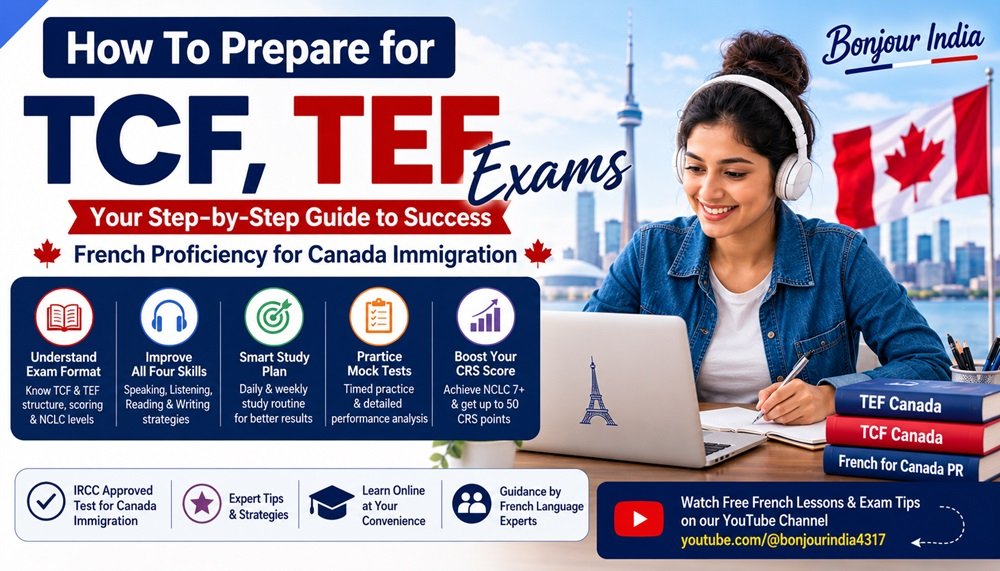
How To Prepare for TCF, TEF Exams: Follow a 30-Day Plan
If your examination is approaching, a focused 30-day plan can help organize your preparation.
Days 1–7: Assess and Build
- Take a diagnostic test
- Identify weak areas
- Revise grammar basics
- Build vocabulary
- Start daily listening practice
Days 8–15: Skill Development
Focus on:
- Reading comprehension
- Listening exercises
- Speaking practice
- Writing exercises
- Vocabulary expansion
Days 16–23: Exam Practice
Increase your use of:
- Timed exercises
- Section-wise tests
- Speaking simulations
- Writing tasks
- Listening practice
Days 24–30: Mock Test and Revision
Take full practice tests and analyse your results.
Focus primarily on your weak areas rather than trying to learn everything again.
Common Mistakes to Avoid During TCF and TEF Preparation
Studying Without a Plan
Random practice can make your preparation inefficient.
Ignoring Speaking
You cannot build speaking confidence without speaking regularly.
Focusing Only on Grammar
Grammar is important, but the exams require balanced language skills.
Avoiding Mock Tests
Without timed practice, candidates may struggle with exam pressure.
Memorizing Complete Answers
Memorized responses can sound unnatural and may not work when the question changes.
Starting Too Late
French proficiency takes time to develop. Starting early gives you more opportunity to improve.
How To Prepare for TCF, TEF Exams with Online Coaching
Online French coaching can be especially useful for students and working professionals.
A structured online course can provide:
- Live classes
- Speaking practice
- Grammar training
- Vocabulary development
- Listening exercises
- Writing correction
- Mock tests
- Trainer feedback
- Flexible schedules
If your goal is Canada immigration, consider a course that combines general French learning with specific TCF Canada or TEF Canada preparation.
👉 Related Article: Online French Course for Canada Immigration
👉 Related Article: French Classes in India
TCF, TEF Exam Preparation for Canada PR
French can play an important role in an Express Entry strategy.
Under the current CRS criteria, candidates with NCLC 7 or higher in all four French abilities may receive:
- 25 additional CRS points when their English is CLB 4 or lower, or they do not have an English test.
- 50 additional CRS points when they also have CLB 5 or higher in all four English abilities.
IRCC also currently has a French-language proficiency category under Express Entry, where eligible candidates need at least NCLC 7 in all four French abilities.
This makes strong French preparation particularly relevant for candidates considering Canadian immigration.
However, immigration rules and selection criteria can change, so always check the latest IRCC information before making application decisions.
Why Choose Bonjour India for TCF and TEF Preparation?
Bonjour India provides French language training for students, professionals, and Canada immigration aspirants.
Training can include:
✔ A1 to B2 French courses
✔ TEF Canada preparation
✔ TCF Canada preparation
✔ Speaking practice
✔ Listening exercises
✔ Reading practice
✔ Writing guidance
✔ Grammar and vocabulary
✔ Mock tests
✔ Personalized feedback
✔ Online classes
Whether you are a complete beginner or already preparing for your exam, structured guidance can help you work toward your target level.
🌐 Website: French Coaching – Bonjour India
📞 Call / WhatsApp: +91 8511698809
📍 Location: Google Maps – Bonjour India
Learn TCF and TEF Preparation Tips on YouTube
Continue your French learning journey outside your regular classes with useful lessons, pronunciation guidance, speaking practice, and TCF/TEF preparation tips.
▶️ Bonjour India YouTube Channel: Bonjour India on YouTube
Regular exposure to French can help reinforce your vocabulary, pronunciation, listening, and speaking skills.
Frequently Asked Questions How To Prepare for TCF, TEF Exams
Is TEF Canada accepted for Canada immigration?
Yes. IRCC lists TEF Canada as an approved French-language test for Express Entry.
Is TCF Canada accepted for Canada immigration?
Yes. TCF Canada is also listed by IRCC as an approved French-language test for Express Entry.
Should I prepare for TEF or TCF?
Both tests are accepted for eligible Canadian immigration purposes. Your choice can depend on test availability, format, preparation preferences, and your individual circumstances.
How long should I prepare for TEF or TCF?
There is no single preparation period that works for everyone. Beginners may need several months to build their French foundation, while intermediate learners may be able to move into exam-specific preparation sooner.
Can French improve my CRS score?
Yes. Under the current CRS criteria, strong French results can provide up to 50 additional CRS points when the applicable French and English requirements are met.
Conclusion
Learning How To Prepare for TCF, TEF Exams requires a combination of strong French fundamentals, regular practice, exam-specific strategies, and mock-test experience.
Start by assessing your current level and building your foundation in grammar, vocabulary, pronunciation, and everyday communication. Then gradually increase your focus on listening, reading, writing, and speaking under timed conditions.
If Canada immigration is your goal, working toward a strong NCLC result can be particularly valuable. Current IRCC rules provide up to 50 additional CRS points for eligible candidates with strong French and the required English results.
Start your French preparation today and take a confident step toward your TCF Canada or TEF Canada goal.
Related Articles You Should Read
- TEF Canada Preparation Online
- TCF Canada Preparation Online
- TEF Canada Mock Test Course
- TEF and TCF Canada Exam Preparation Strategies for Beginners
- French Classes in India
- Online French Course for Canada Immigration
Important: Immigration requirements, CRS rules, test formats, and selection policies can change. Verify current requirements with IRCC before registering for a test or submitting an immigration application.