
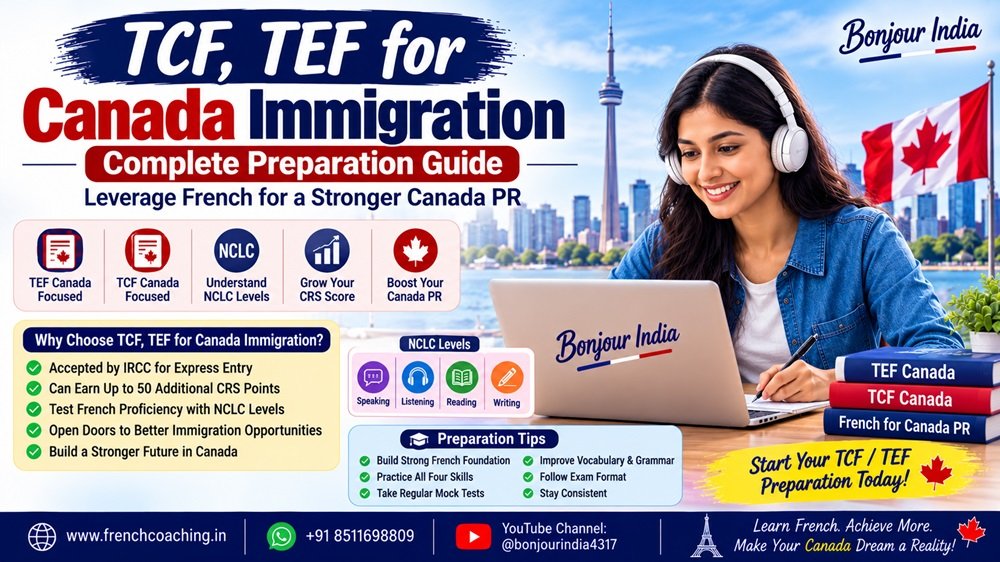
TCF, TEF for Canada Immigration: Complete Preparation Guide
If you are planning to immigrate to Canada, French language proficiency can be a valuable part of your immigration strategy. TCF, TEF for Canada Immigration are the two approved French-language tests that can be used to demonstrate French proficiency for Express Entry and other eligible Canadian immigration pathways.
Both TEF Canada and TCF Canada are recognized by Immigration, Refugees and Citizenship Canada (IRCC). Your results are evaluated using the Niveaux de compétence linguistique canadiens (NCLC), Canada’s French-language benchmark system.
For Express Entry candidates, strong French results can also provide additional CRS points. IRCC currently states that candidates who achieve NCLC 7 or higher in all four French abilities may receive up to 50 additional CRS points, depending on their English results.
Why Choose TCF, TEF for Canada Immigration?
French can strengthen an Express Entry profile and may open additional opportunities for candidates with strong French-language skills.
Choosing between TCF Canada and TEF Canada depends on your preparation preferences, availability, and the test format you are more comfortable with.
Both tests can be used as approved French-language tests for Express Entry.
TCF, TEF for Canada Immigration and CRS Score
French can contribute to your CRS profile in two ways: through language proficiency points and potentially through additional French-language points.
According to current IRCC criteria, candidates who achieve NCLC 7 or higher across all four French skills can receive:
- 25 additional CRS points if their English results are CLB 4 or lower, or they did not take an English test.
- 50 additional CRS points if they also achieve CLB 5 or higher in all four English skills.
French does not guarantee an Invitation to Apply, but a stronger CRS score can improve your ranking in the Express Entry pool.
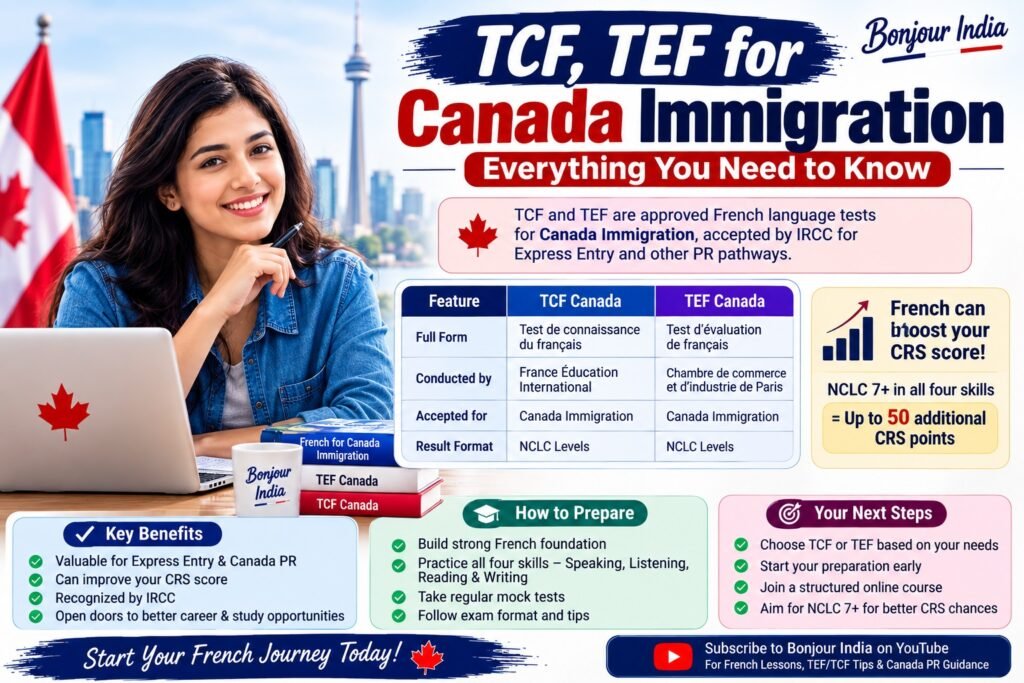
TCF, TEF for Canada Immigration: Which Test Should You Choose?
Both tests are accepted by IRCC for Express Entry, so there is no universal answer to which test is “better.”
The right choice depends on factors such as:
- Your preferred test format
- Availability of test dates
- Availability of test centres
- Your current French level
- Your strengths in different language skills
- Your preparation resources
- Your target immigration pathway
Before registering, always verify the latest requirements and test information from the official sources.
TCF Canada
TCF Canada stands for Test de connaissance du français.
It is an approved French-language test for Canadian immigration and measures French proficiency in the required language abilities. IRCC uses NCLC equivalencies to assess the results.
👉 Related Article: TCF Canada Preparation Online
TEF Canada
TEF Canada stands for Test d’évaluation de français.
It is also an approved French-language test for Canadian immigration. Candidates receive results for the relevant test components, which are converted into NCLC levels for immigration purposes.
👉 Related Article: TEF Canada Preparation Online
TCF, TEF for Canada Immigration: Understanding NCLC Levels
One of the most important concepts for Canada immigration candidates is the NCLC level.
NCLC is the Canadian benchmark used to measure French proficiency.
Your performance is evaluated across four language abilities:
- Speaking
- Listening
- Reading
- Writing
For Express Entry, IRCC provides specific score ranges and NCLC equivalencies for both TEF Canada and TCF Canada.
Why NCLC 7 Is Important
NCLC 7 is an important target for many candidates because strong French results at NCLC 7 or above in all four abilities can qualify an Express Entry candidate for additional CRS points, subject to the applicable English-language conditions.
Therefore, your preparation should focus on achieving a consistent level across all four skills, rather than becoming highly proficient in only speaking or listening.
TCF, TEF for Canada Immigration: Four Skills You Need to Prepare
Whether you choose TCF Canada or TEF Canada, your French preparation should cover the skills required by your chosen examination.
Speaking Preparation
Speaking practice is essential for developing fluency and confidence.
Practise:
- Introducing yourself
- Asking questions
- Expressing opinions
- Describing situations
- Giving arguments
- Responding spontaneously
- Using appropriate vocabulary
👉 Read: TEF Canada Speaking Preparation
Listening Preparation
Listening can be challenging because candidates need to understand French quickly.
Improve by:
- Listening to French conversations daily
- Watching French videos
- Practising exam-style audio
- Identifying keywords
- Understanding context
- Practising under timed conditions
Reading Preparation
Regular reading can improve vocabulary and comprehension speed.
Practise with:
- French articles
- Advertisements
- News content
- Everyday texts
- Practice questions
- Exam-style passages
Writing Preparation
Writing requires good vocabulary, grammar, organization, and clarity.
Practise:
- Sentence construction
- Connectors
- Formal vocabulary
- Informal vocabulary
- Grammar
- Organizing arguments
- Writing within time limits
How to Prepare for TCF, TEF for Canada Immigration
A structured preparation strategy can make your French learning more effective.
Step 1: Assess Your Current French Level
Start by identifying your current proficiency.
If you are a complete beginner, you may need to develop your French from A1 and A2 before progressing toward B1 and B2.
Step 2: Build Strong French Foundations
Focus on:
- Grammar
- Vocabulary
- Pronunciation
- Sentence formation
- Everyday communication
👉 Related Article: French A1 A2 B1 B2 Course Online
Step 3: Practise All Four Skills
Do not spend all your preparation time on speaking.
Create a balanced routine covering:
Speaking + Listening + Reading + Writing
Step 4: Begin Exam-Specific Preparation
Once your French foundation is strong, start working with TCF Canada or TEF Canada-style questions and timed exercises.
Step 5: Take Regular Mock Tests
Mock tests help you understand your progress and identify weak areas.
👉 Related Article: TEF Canada Mock Test Course
TCF, TEF for Canada Immigration: Why Mock Tests Matter
Mock tests are an important part of exam preparation.
They can help you:
- Understand the test structure
- Practise time management
- Identify weak areas
- Improve speed
- Reduce exam anxiety
- Measure progress
- Become familiar with exam-style questions
After every mock test, review your mistakes carefully.
Instead of simply asking, “What was my score?”, ask:
Why did I lose marks?
This approach helps you target your preparation more effectively.
TCF, TEF for Canada Immigration: Build a Daily Study Plan
Consistency is more important than studying for long hours occasionally.
A simple daily schedule could include:
20 minutes: Vocabulary
20 minutes: Listening
20 minutes: Reading
20 minutes: Speaking
20 minutes: Writing and grammar
You can adjust the schedule according to your current level, available time, and target examination date.
Weekly Preparation Strategy
A weekly routine could look like:
Monday: Vocabulary + Listening
Tuesday: Grammar + Reading
Wednesday: Speaking + Vocabulary
Thursday: Writing + Grammar
Friday: Listening + Reading
Saturday: Speaking + Writing
Sunday: Mock test + mistake analysis
The key is to maintain consistency.
TCF, TEF for Canada Immigration: Common Preparation Mistakes
Many candidates make avoidable mistakes during their preparation.
Studying Without a Target
Know your desired NCLC level and create a preparation plan around it.
Ignoring Weak Skills
A candidate may be strong in speaking but weak in writing. All relevant skills require attention.
Memorizing Complete Answers
Memorizing answers can limit your ability to respond naturally to unexpected questions.
Avoiding Mock Tests
Without mock tests, you may underestimate the importance of speed and time management.
Starting Exam Preparation Too Late
Building French proficiency takes time. Starting early gives you more opportunities to improve.
TCF, TEF for Canada Immigration: Online French Coaching
Online French coaching can be especially useful for students and working professionals who need flexible learning options.
A structured online program can provide:
- Live instructor-led classes
- Speaking practice
- Grammar training
- Vocabulary development
- Listening exercises
- Writing correction
- Mock tests
- Exam strategies
- Personalized feedback
If your ultimate objective is Canada PR, consider choosing a course that combines general French development with TEF Canada or TCF Canada preparation.
👉 Related Article: Online French Course for Canada Immigration
How Bonjour India Helps with TCF, TEF for Canada Immigration
Bonjour India provides French language training for learners preparing for French proficiency exams and Canada immigration.
Our training can include:
✔ A1 to B2 French language courses
✔ TEF Canada preparation
✔ TCF Canada preparation
✔ Speaking practice
✔ Listening exercises
✔ Reading practice
✔ Writing guidance
✔ Vocabulary and grammar
✔ Mock tests
✔ Personalized feedback
✔ Online classes
Whether you are starting from beginner level or already preparing for your examination, structured guidance can help you progress more confidently.
TCF, TEF for Canada Immigration and Canada PR
For Express Entry candidates, French can be an important part of an overall immigration strategy.
IRCC currently accepts TEF Canada and TCF Canada as approved French-language tests for Express Entry. Test results are converted to NCLC levels for immigration assessment.
Candidates who achieve NCLC 7 or higher in all four French abilities may qualify for up to 50 additional CRS points depending on their English-language results.
IRCC also highlights opportunities for French-speaking skilled workers through Express Entry and notes the potential benefit of strong French-language proficiency.
However, immigration criteria can change. Always verify the latest requirements before making decisions about your application.
Start Your TCF, TEF for Canada Immigration Preparation Today
If Canada PR is your goal, developing French proficiency can be a worthwhile long-term investment.
Start by assessing your current level, choose between TCF Canada and TEF Canada based on your circumstances, and follow a structured preparation plan.
🌐 Website: French Coaching – Bonjour India
📞 Call / WhatsApp: +91 8511698809
📍 Google Maps: Bonjour India Location
Learn More About TCF, TEF for Canada Immigration on YouTube
Continue your French learning journey with free lessons, pronunciation guidance, TEF and TCF preparation tips, and Canada PR-related French content.
▶️ Bonjour India YouTube Channel: Bonjour India on YouTube
Regular practice outside your classes can help reinforce your vocabulary, grammar, pronunciation, listening, and speaking skills.
Frequently Asked Questions About TCF, TEF for Canada Immigration
Is TCF Canada accepted for Canadian immigration?
Yes. IRCC lists TCF Canada as an approved French-language test for Express Entry.
Is TEF Canada accepted for Canadian immigration?
Yes. TEF Canada is also an approved French-language test for Express Entry.
Which is better, TCF Canada or TEF Canada?
Both are accepted by IRCC. The better option depends on your circumstances, preferred test format, preparation approach, and test availability.
Can French increase my CRS score?
Yes. Under the current CRS criteria, strong French proficiency can provide up to 50 additional CRS points when the applicable NCLC and English-language requirements are met.
How long are language test results valid?
For Express Entry, language test results must generally be less than 2 years old when you create your profile and when you submit your permanent residence application. Always check the current IRCC requirements before applying.
Conclusion
TCF, TEF for Canada Immigration preparation requires more than memorizing vocabulary or practising a few sample questions. Successful preparation involves developing your French proficiency across speaking, listening, reading, and writing while becoming familiar with the specific test format.
Both TCF Canada and TEF Canada are approved French-language tests for Express Entry. Strong French proficiency can also provide significant CRS benefits for eligible candidates, including up to 50 additional CRS points under the current criteria.
Start your French learning journey early, practise consistently, take regular mock tests, and focus on achieving your target NCLC level.
Ready to prepare for TCF Canada or TEF Canada? Start learning French with Bonjour India today.
Related Articles You Should Read – Click Here
- TEF Canada Preparation Online
- TCF Canada Preparation Online
- Online TCF Canada Coaching
- TEF Canada Mock Test Course
- TEF Canada Speaking Preparation
- Online French Classes for TEF
- French Classes in India
- French Classes for Canada PR Online
- Learn French Online for Canada PR
- French for Canada PR CRS Score
- Online French Course for Canada Immigration
- French A1 A2 B1 B2 Course Online
- French Speaking Course
- French Vocabulary Course
- French Grammar Course Online